When I found out that Baynard House is to be redeveloped, I was glad. This is because I think it’s the ugliest building in London.
This isn’t a controversial view. Baynard House was described by Pevsner Architectural Guides as “acutely depressing”. George Ferguson of the Royal Institute of British Architects said it’s “more akin to a car park than an office building”.
Over the past year, I dedicated some time to finding out how something so spectacularly ugly ever came to be. I only got a partial answer to my question, but it was fun trying to find the answers. I’ve summarised what I learned below.
The Construction
Baynard House was built for the government-owned Post Office, between 1972 and 1979. Designed by William Holford & Associates and constructed by partners including Ove Arup and John Laing, it began operations in 1980. Just around then, the incoming Thatcher government separated the Post Office and British Telecom - which has since been privatised and has rebranded as BT. (I’ll refer to it by that name throughout this post for brevity’s sake - though some of the people I quote will use “PO”, meaning “Post Office”. We all mean the same organisation.)
When it was opened, Baynard House housed some then-revolutionary telephone exchange technology. From 1982 to 1997, it hosted a small museum, open to the public. But the building’s considerable floorspace was never used to its full capacity. And it’s a lot emptier these days, though its original exchange kit is still (just about) operational.
Baynard House’s spectacularly prominent location sharpens its ugliness. It’s on Queen Victoria Street, next to the river. On the other side of the river is the main viewing gallery of Tate Modern, which means thousands of visitors a day have their photos ruined by this sorry, low-slung, clapped-out concrete bunker. It’s built near the point where the old river Fleet (now buried) met the walls of the City of London and the Thames. There used to be a medieval palace there, Baynard’s Castle, which was destroyed in the great fire of 1666.
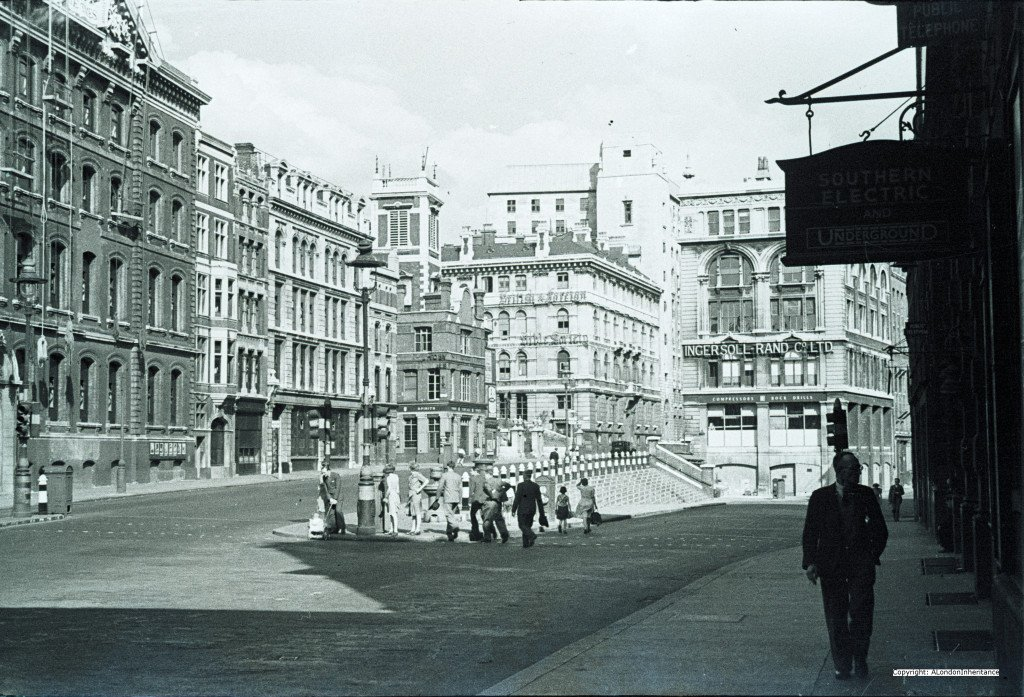 Image source: Skyscrapercity
Here’s a before and after. In a photo taken just before construction of Baynard House started, you can see some handsome but nondescript Victoriana (on the right of the image above). Which was replaced with… this, on the right below. The square white tower of the Faraday Building (centre), one of the first telephone exchanges in the UK, is one of the few points of commonality between the two scenes.

Image source: Skyscrapercity
To see the extent of the demolition, and the prominence of the riverside location, here’s a construction image. Baynard House takes up the entire section to the left of the S-bend road sloping down to the river.
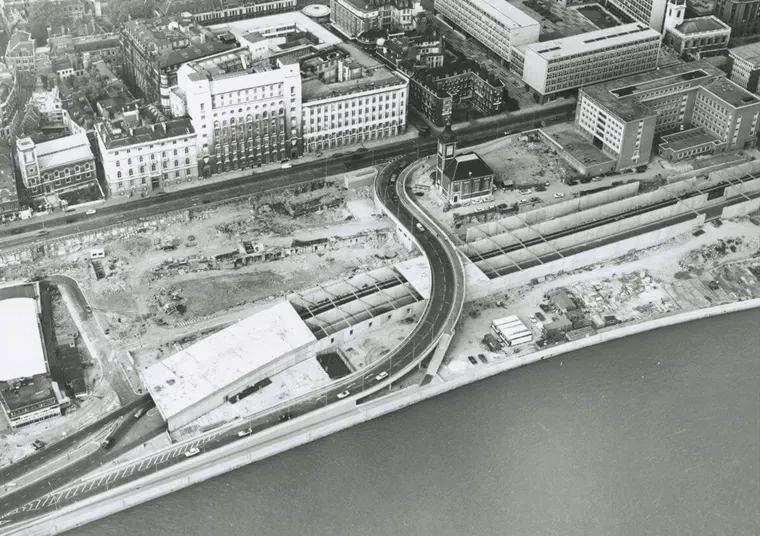 Image source: Skyscrapercity
Here’s a view of present-day Baynard House from the river (taken from the Millennium Bridge).
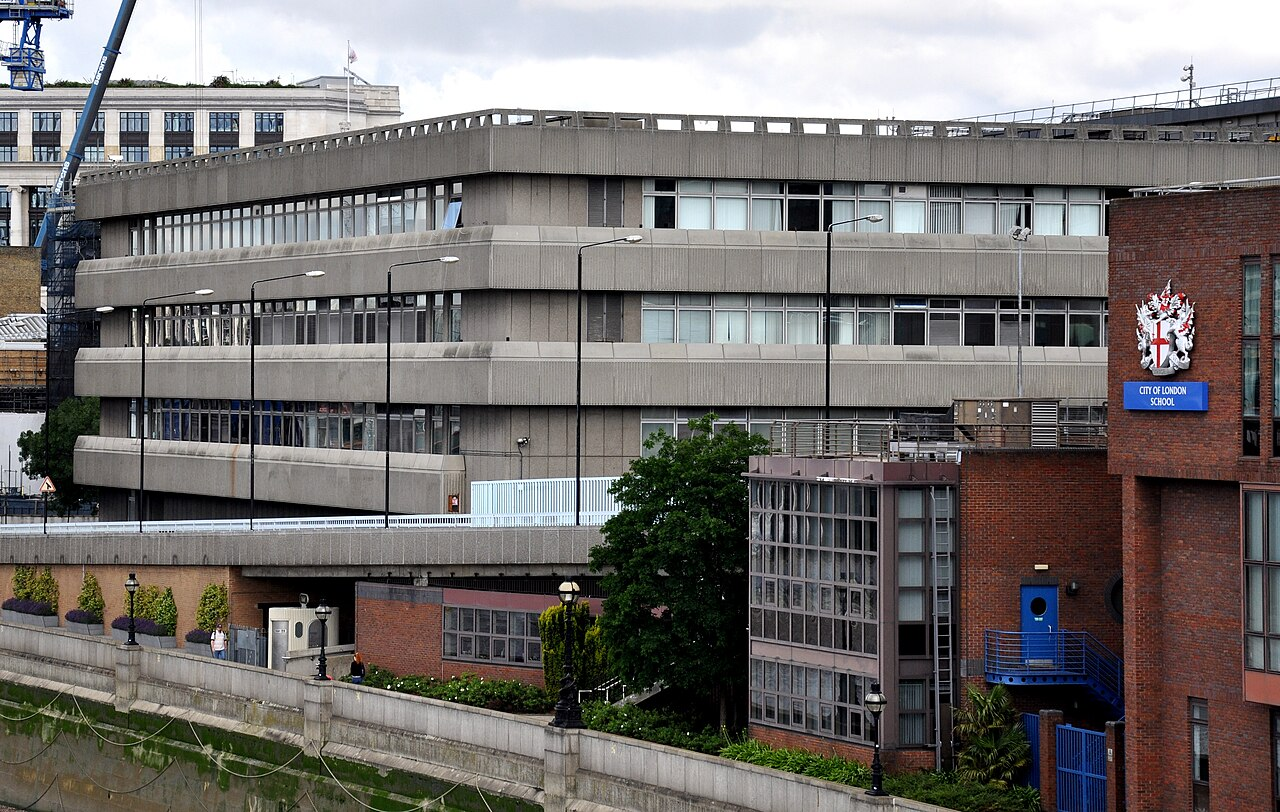 Image source: Wiki commons

Things get even uglier on the other side of the building. An upstairs seating area is adorned with a bizarre sculpture: a totem pole of decapitated heads by sculptor Richard Kindersley, representing the seven ages of man. In my many visits to this transfixingly horrible space over the years, none of the benches have ever been occupied.
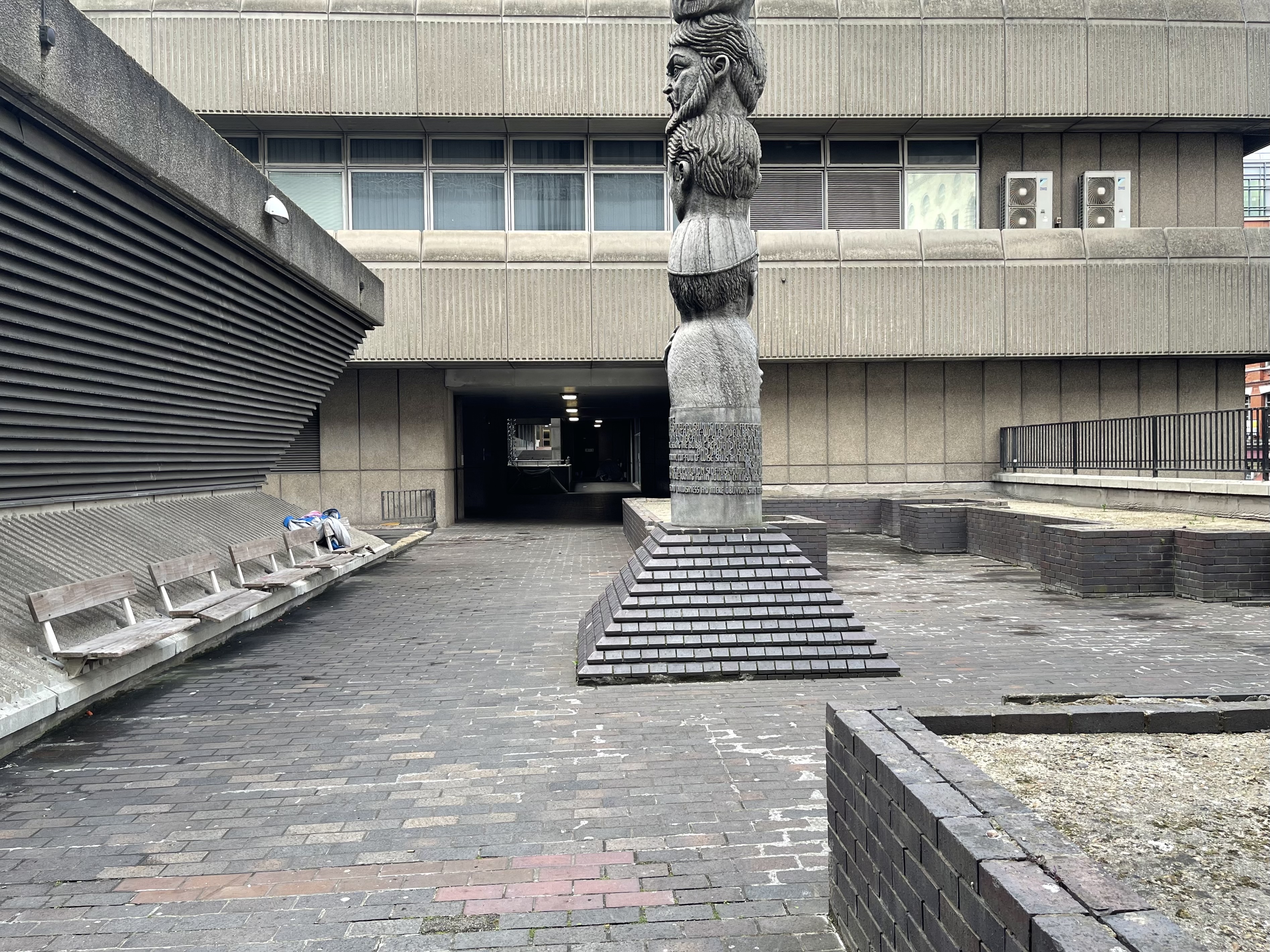
The ‘Main Entrance’ to the building is just inside the dark portal next to the public square. It still sports a BT logo, one of the few signals there is life (and telecom workers, and exchange equipment) inside. No part of the internal building is visible through its ungenerous, blacked-out windows. Two defensive A4 paper notes were stuck next to the door, as further evidence:
Please don’t leave anything outside of this building. It will be seen as a security risk and Police will be contacted.
And:
DEAR ALL - PLEASE MAKE SURE YOU CLOSED THE DOOR BEHIND YOU. THANK YOU.
In sum, has a building ever been more unwelcoming? Despite being in early middle age, Baynard House is delapidated, pointless, begging for an unmourned death.
What will replace Baynard House? There have been a few design proposals over recent years, the latest of which is still at the planning stage. Baynard House will stand for a couple more years. But it will almost certainly not survive much longer.
The Selloff
I’d been obscurely intrigued by this ugly building for years. I found out that it was doomed via Lisa Kinch, a Swedish architect who has been documenting British telephone exchanges as part of her PhD project.
I visited a display of her work at a BT office a few months back (this office was a perfectly inoffensive modern glass box in Aldgate). From there, I found out that BT maintains an archive of historical documents, which is free to visit. It’s hosted at a former telephone exchange in Holborn. I also attended a talk Lisa Gave at the 20th Century Society in November 2024.
Lisa explained that, in the late 1990s, BT sold its exchanges to a property investment company called Telereal Trillium on a 30 year lease. While the company retains the option to buy back the entire estate, this would cost between £3bn and £5bn. They also have the option to extend the lease by 10 years at the cost of £2bn. Neither are promising solutions for a publicly-traded company with shareholders to please.
So, to lessen the financial burden, BT is prioritising the decommissioning and exiting of high cost sites. Kinch says that Baynard House, with its spectacularly prominent location, is close to the top of the list, and will close by 2028. In all, 108 BT buildings are scheduled to close by 2031 (the Archives and the Holborn exchange I mention in the next section are in a latter phase but will be gone by then, too).
Few to none of the old exchanges will be listed or saved, which Kinch thinks is a shame. But the brutal reality - which she also acknowledges - is that these are generally unlovely industrial buildings that were built in a hurry. They’re difficult to adapt to become homes or offices. In a few years, many will be gone.
The Archives
While on aesthetic grounds, Baynard House’s death sentence is deeply deserved, I was still curious about the building.
To learn more, I visited the archives a couple of times over the past year or so, and dug up and read through as much as I could on the topic. Here’s a photo of what the archives look like.
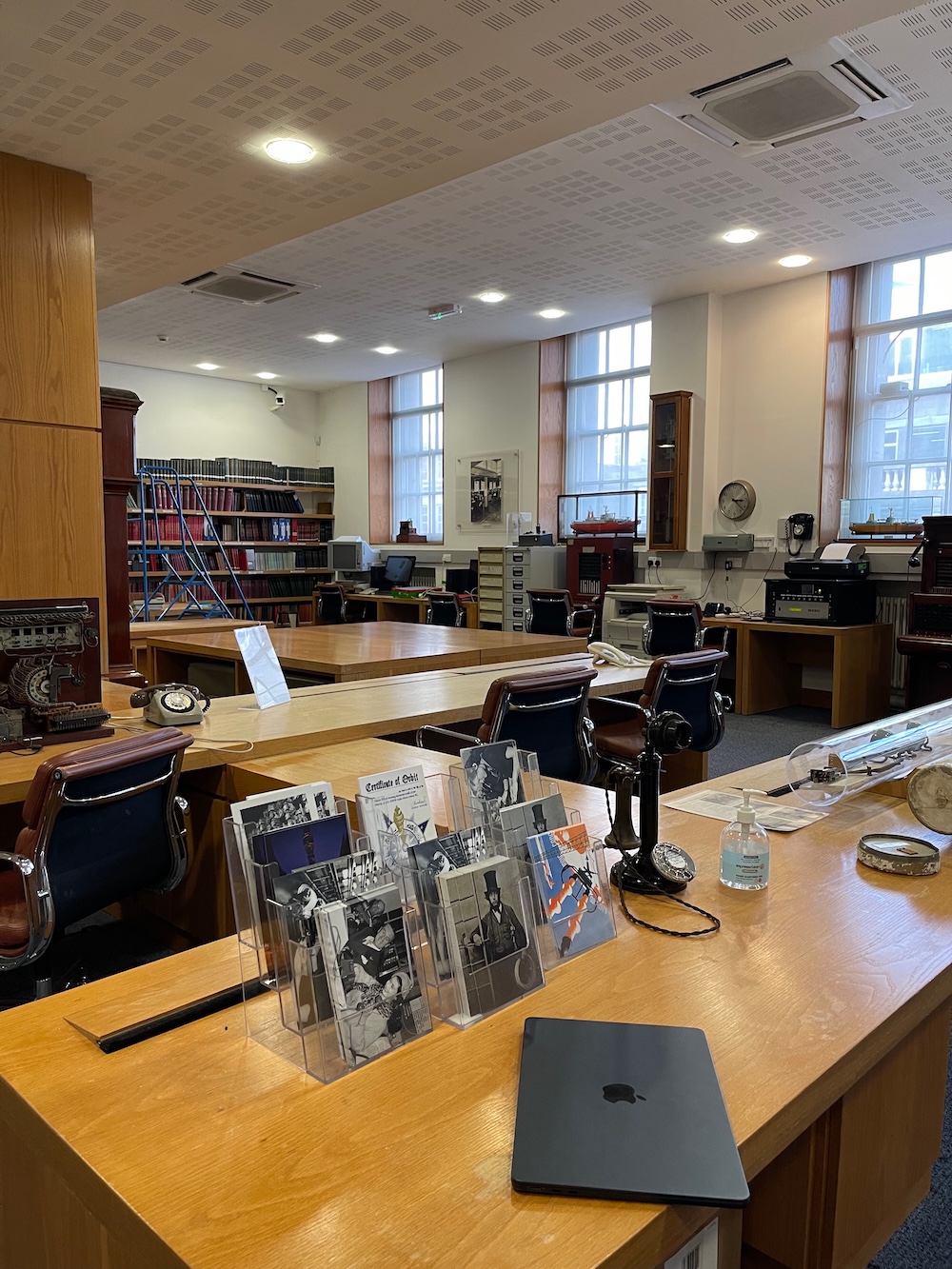
The bulk of the documents held in the archive about Baynard House are exchanges of letters and memos from Post Office managers and executives. Almost none of them reference the building’s architecture, and I found no evidence of correspondence with the architects or engineers during the building’s construction.
The standout ugliness of the building - the most arresting thing about it today - wasn’t a concern for these BT executives. Or at least, wasn’t a concern worthy of being detailed in a memo.
Instead, the correspondence focuses on more pressing issues. First and foremost, the then-revolutionary exchange equipment contained in the building.
The Exchange
Baynard House was the future, once. It opened in July 1980, six months ahead of schedule. A press release from that April comes closest of all the documents I studied to describe the building itself. It leaves design aside entirely, and focuses instead on cost:
We have been extremely fortunate to secure this important site which is leased from the City on a 99 year lease with an initial payment of £0.5m and an annual rental of £0.235m. The building… completed last year at [a] cost of approximately £20m.
There is some discussion of the Kindersley sculpture, too:
In view of historical interest of the Baynard House site, it was thought appropriate to have some commemorative sculptural feature associated with the building. For his interpretation of the commission the designer, Mr Richard Kindersley chose the Elizabethan Period and a Shakespearian theme. The Globe Theatre was of course just across the river and Baynard House itself is next door to the Mermaid Theatre. The sculpture depicting The Seven Ages of Man from Shakespeare’s As You Like It, cost £10,000.
Aesthetics aren’t referenced at all, naturally.
The new Baynard House was the first exchange to host digital switching technology, as part of a project called System X. It’s this fact that is the focus of the coverage. The building opened in September 11th 1980, and an image from the press conference there is below.
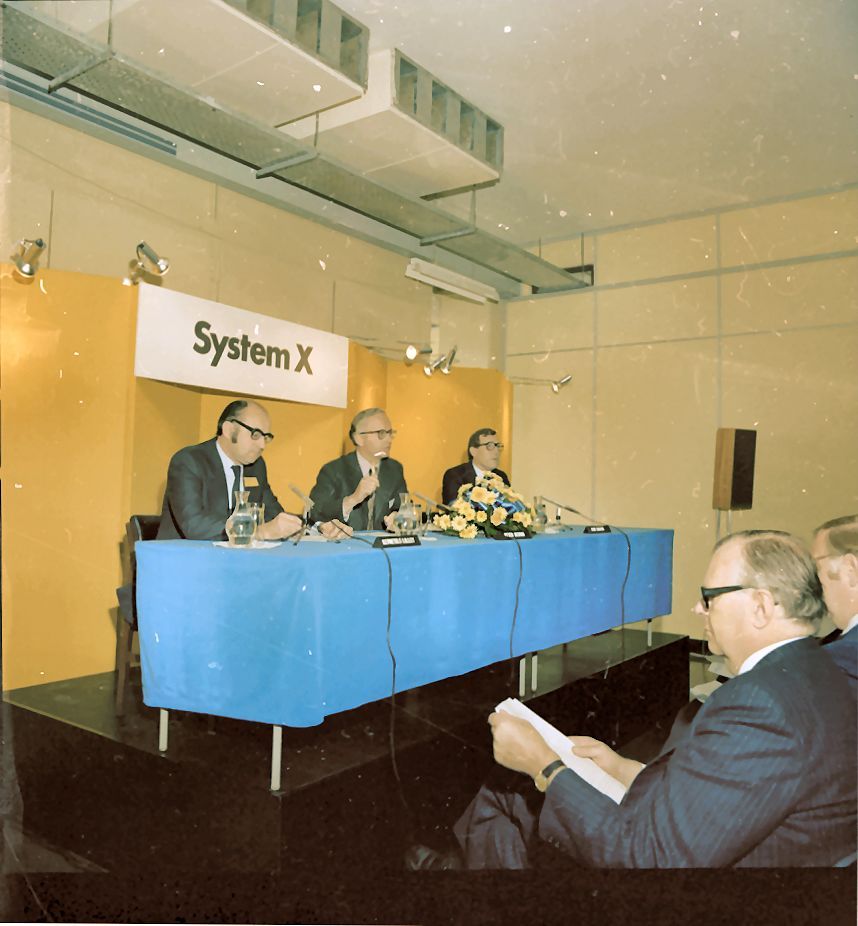 Image source: BT Archive
Peter Benton, Managing Director of British Telecom, said of the launch:
This exchange stands for all that is best in British achievement. It symbolises British research, design and manufacturing skills, the cream of British communications technology and British determination to deliver not only on time but ahead of time… because it is a potential world beater, it stands to figure in an export drive on a massive scale that will have a significant impact on our British balance of payments position.
But what was this potential “world beater” System X?
System X
Baynard House was the first BT exchange to use digital switching to connect telephone circuits, in order to make phone calls. This was a step-change replacement to the older analogue, electro-mechanical systems used since the invention of the telephone, more than a century earlier. These connected calls literally by holding bits of metal together.
This digital switching system was known as System X, and was a joint venture from state-owned BT and other more-or-less privately owned telecoms companies: GEC, Plessey and STC. All of these organisations were headquartered in Britain, meaning that the success of System X became a point of national pride - in case that wasn’t entirely obvious from Benton’s quote above.
It was nothing less than “the key to our future”, as one internal BT leaflet had it.
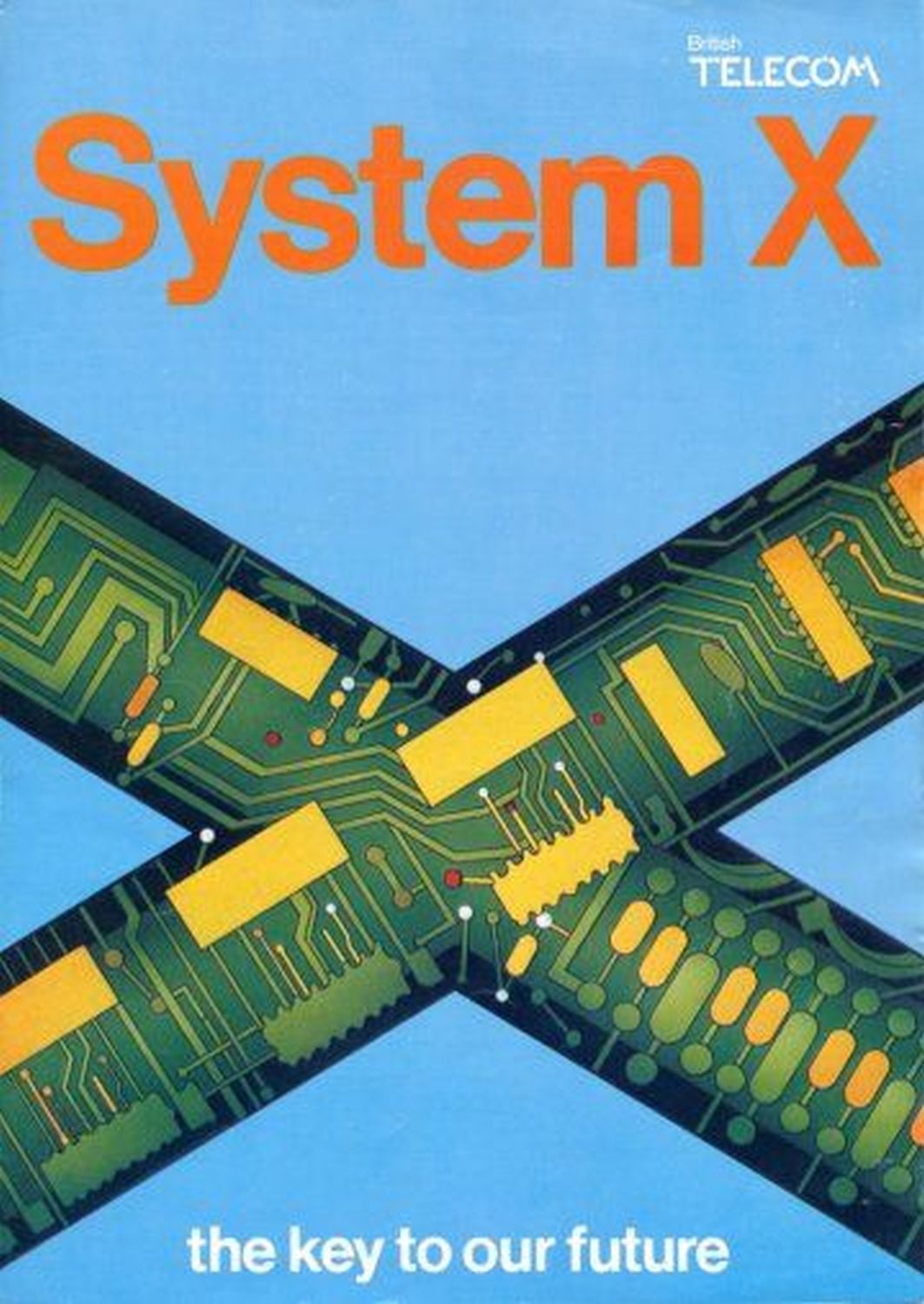 Image source: BT Archive
The improved digital technology did have some built-in benefits. First and foremost, increased reliability (separate BT communications of the time boast about connections being “noise free”). But it also made possible feature advances like abbreviated dialling using a short code and three-way phone conversations.
More revolutionary benefits were to come. System X was intended to, as the press release has it:
…form the basis of a new digital ‘grid’ that will link the main population centres of the country before the end of the decade… this new grid will become a high-speed multi-purpose communication network bringing the benefits and facilities of System X to the nation’s business community at the earliest possible date.
In here we can see the very early stirrings of the home internet that would become ubiquitous in future decades. And, beyond the home, a 1980s booklet for BT staff, listing the benefits of the service, imagines a System X-enabled “office of the future”, in which we will have “multi-function business terminals, enabling simultaneous transmission of voice and ‘non-voice’”, “electronic mail” and “an integrated paperless system for data acquisition and all usual functions”.
So, what actually happened? From a promising start, System X didn’t fulfil the high hopes placed in it.
While much of the kit is still in operation in the 2020s, the system may be considered a failure: it launched later than similar digital systems from international rivals, such as Ericsson, and didn’t become an export success - let alone alter the nation’s “balance of payments”, as Benton predicted. Rival systems were simpler to implement and better adapted to later IP-based networks.
And Baynard House remained largely empty.
The Project
That 1980 launch also came at the end of a long and much-delayed build-out. Not of the building itself, as far as I can tell, but of the exchange technology.
System X project’s tortured genesis is clear from some of the archive material. There are records of the Joint Managing Directors’ Meetings from 1975. These were essentially a series of regular, ad hoc meetings on the development of System X held between senior management in the Post Office, usually involving primary commercial suppliers (GEC, Plessey, STC).
These meetings chart a project struggling under its own ambition. System X was unlike anything the Post Office had previously attempted. It was, in effect, a vast software programme at a time when large-scale software engineering was still poorly understood. Control of the network depended on hundreds of thousands of lines of code written concurrently by multiple organisations, each with their own commercial interests, working practices and internal politics. Unsurprisingly, coordination proved difficult.
Handovers were frequent - and frequently delayed. One set of project update notes headed LIST OF SLIPPED INTERCHANGES (SLIP IN BRACKETS IN WEEKS) are particularly brutal. For example, one “cause of slip” is simply “lack of effort”. The effect of the slip is “delays integration”. The action for the project team is: “Integration strategy revised and steps being taken by PTL to increase effectiveness of the Liverpool software staff.” Plessey is based in Liverpool, and presumably some unfortunate staff got pulled away for a punishment beating.
 System X circuit boards (at Baynard House!) Image source: BT Archive
The blame game extended up the management chain. Managing director Benton is revealed in these memos as having profound doubts about the programme’s success. In a 1978 note titled ‘Progress with System X’, signed by a “PFB” (Benton’s middle name was “Faulkner”, so it’s surely him), a low seems to have been reached. The cause is the software:
It is the first time that the PO and the contractors have designed a system depending for its control on the very large scale use of software.
Benton notes that three companies helped design the software, and ought to maintain standards. But there’s a “natural secrecy” and “commercial jealousies” of each other and “commercial defensiveness against the PO”. Squabbles over “design freezes” and handovers intensify, even as system design and implementation had to take place at the same time due to short timescales.
This led to terrible pressures and a “very high turnover of staff in project teams” - reaching 25% per annum. There is mention after mention of a talent gap - “a present shortage of some 5-20,000 trained computer programmers and systems analysts with a requirement for an additional 5,000 each year”.
To meet the staff shortages, “we shall continue to employ software houses under contract as much as possible” - which, then and now, cost more. Benton adds, in a memo:
In the face of external criticisms about our plans and progress we may be tempted to take panic measures which will result in a ‘more haste less speed’ situation.
Sir William Barlow, who became Chairman of the Post Office in 1977, backed up this view in a later oral history interview. He recalled that while the system was technically impressive - “advanced, comprehensive, state-of-the-art”, its delivery was faltering badly, and there were serious doubts about whether to proceed at all.
Rival systems from overseas suppliers, notably Ericsson in Sweden, appeared simpler and further advanced. Barlow admitted to concerns about poor programme management, and said that, at one point, the programme was at risk of being cancelled. (Ericsson, naturally, made an offer to supply the kit.)
Eventually, Barlow said, still more external contractors - this time programme managers - “knocked some shape into the programme and introduced some programme management techniques, which we used. It’s very interesting as I’m talking now, many years later, that programme management has become a well-known consultancy area in itself”.
Geneva
One pivotal moment came in 1979, when System X was demonstrated at a major international telecommunications exhibition in Geneva - TELECOM ‘79.
Internally, the run-up to the event was fraught. Correspondence from early 1979 shows Benton describing the risk of failure at Geneva as “intolerably high”, with urgent discussions about overtime, shift working and emergency staffing to get the demonstration ready.
Barlow sent out a memo that ratcheted the pressure up still further, as well as illustrating some of the paranoia and defensiveness familiar to many a sponsor of a project that’s running late and over budget:
Some of it is no doubt inspired - by overseas competitors, monopoly-breakers, and those out of sympathy with Britain, PO, nationalised industries etc; …. We know that there are unathorized(sic) leakages from the design teams to the press, which emphasise the detailed problems and magnify them out of context. Geneva provides a unique opportunity, … to put the record straight.
You can see some of this press scepticism in pre-submitted questions to Barlow from an “Industrial Correspondents lunch” later in 1979, which include:
How is System X developing? Are’nt(sic) you so far behind, that very very few markets are left open to you?
The demonstration at TELECOM ‘79 turned out to a success, and Barlow later recalled feeling that “The Brits are back! [It was a] final launchpad for the system.”
Even after this success and ahead of the launch, worries persisted - this time about strikes. Benton grumbles that “since the demonstration the industrial relations problems have flared up in a way which is likely to have a serious effect on completion of the work for the Geneva model”. (It was the winter after the Winter of Discontent, after all.) Meanwhile, a Plessey executive wrote:
I… have instituted an action programme identifying transfers of specific skills from lesser priority tasks while at the same time attempting to improve our recruiting success rate. This should allow the key dates for Baynard House to be maintained, provided we do not meet with Union resistance on the Liverpool site.
Evidently, these didn’t knock the launch too far off course. “Baynard House” was built. The System X exchange housed within its hideous concrete walls became operational. Given the pressures around the project, and its potentially existential impact on the organisation, it’s understandable that architectural quality wasn’t top of mind for BT executives like Benton and Barlow.
That said, it doesn’t explain how the building’s bunker-like ugliness came to be.
The Museum
I didn’t find any smoking guns on this in my remaining archival researches. But I did find one more pointer in some of the non-System X material.
In the first few years of its existence, Baynard House served another function. The Post Office Telecommunications Museum was hosted by Baynard House and was open between 1982 and 1997, after which I assume the general public have never been admitted to the building.
The museum had been without a home for 11 years before that, and the correspondence around its establishment is riddled with concerns about money - and security.
A letter from EW Weaver to FE Jones (director of operational planning) from 1967, pointed out that the exhibition “currently at Fleet” (an office in Shoe Lane, City of London) will be closed and not continued in premises elsewhere. The collection - put together years earlier as part of the Telegraph Centenary celebrations - was due to move out of Fleet in 1973, so they needed to plan the move. With only 400 people per week visiting the exhibit, there wasn’t a sense of urgency around the move.
The Post Office executives actively searched for another location over the following years. (Professor) JHH Merriman, a Board member for technology and Senior Director for Development, wrote in a memo in January 1968 that the recently-constructed Post Office Tower might serve that purpose:
Of course many more would see it - and link it with the Post Office - if it were to be associated with the Tower (”spend an hour in Museum whilst you wait to go up the Tower!”).
The Science Museum was discussed elsewhere as another - cheaper - alternative. As was the ground floor at Lutyens House, Finsbury Circus - though separate memos show that that plan was shut down due to there being a preservation order on that building.
Another director, KH Cadbury, complains in October 1969:
We have been trying to drum up a Director who is prepared to say that money spent on accommodation for the Museum would be worth while.
A day later, a DS Pullin suggests another riverside space further to the east (the spectacular Mondial House, as yet unbuilt but since demolished) as an alternative.
Mondial House as a project is subsequently approved by the board. Weaver states in October 1970 that his managing director:
….was quite firm that the Business should have a museum; that it should be conveniently located for public access and there should be very adequate storage facilities, though not necessarily adjacent to the museum itself. He recognised that such a museum would need to be paid-for.
The last two words underlined by Mr Jones, the planning director, with a note - Who how? His response is icy:
The ‘approval’ which you mentioned does not seem to me to imply expenditure - some would no doubt be needed - or any time scale. No doubt you will bring these matters to attention if/when it becomes necessary to do so…
In the same file is a handwritten note, which is the first reference to having the museum on Queen Victoria Street: “After Mondial/Monument there are several possibilities including Queen Victoria St and North Paddington.” Though it isn’t clear whether this means Baynard House or Faraday House.
With these wranglings ongoing, the Fleet collection closed to the public in September 1971, at which point nobody could visit the collection.
Mondial House didn’t seem to the BT executives at the time like a real solution. A standalone building outside of an exchange seems never to have been considered.
One set of meeting minutes in the archive, from September 1974, state that “security issues”, a lack of toilet facilities and acceptable fire exits, stand against the museum being opened there. Instead, the chairman “would consider whether the Museum could be accommodated in any other ETE [end to end exchange] building in Central London and would advise… accordingly”.
The possibility of Mondial House as a venue is dead as of late 1974. The Post Office went back to Science Museum and a committee organised by The Institution of Post Office Electrical Engineers (IPOEE) - a semi-independent organisation representing engineers’ interests - for advice. It’s not clear from the documents I saw which of these, if either, led to Baynard House coming to the fore as a candidate for hosting the museum. But, by November 1977, a letter to Cadbury from a “K Ford” states:
[a] unique chance to establish the National Telecommunications Museum in an excellent location, at minimum cost and with no security risk to operational service has arisen in the Baynard House project. The opportunity has arisen from a lease condition, placed on the PO by the City of London as site owners, to provide suitable accommodation in Baynard House to rehouse the London Auction Mart (LAM) whose premises formed a part of the development site until they were compulsarily acquired by the City.
This section, earmarked for LAM, is in the northern block of Baynard House: away from the river, next to the street and rather separate from the exchange. But LAM were satisfied by their “interim premises” and didn’t want to move in. Cadbury continues:
I strongly recommend that we proceed with this proposal which I am sure will not only be of considerable interest and benefit to our own staff and outside students of telecommunications but will add to the prestige of the Post Office. The likely opening date, determined by completion of the building project, would be about mid-1979.
A memo from later the same month on the same topic, sent to Cadbury, gives a more unvarnished view of the issue:
We are saddled with the LAM space at Baynard House and it is not required for apparatus for many years because of the turndown in forecast which is leaving substantial areas of the main building surplus for several years. It might be possible to use some of the space for offices but natural lighting is not good.
Cadbury makes a handwritten note in response to the suggestion: “This seems most practical. Any objections?” He later sends an official letter approving the move. This “turndown in forecast” in turn suggests that the longed-for benefits from System X might not be achieved.
Anyway, cost-cutting was paramount. In a January 1980 file from BT’s publicity department, discussing loaning out certain items from the collection, the design of the Exhibition Centre and its tight budget is discussed.
I agree that we must find the money, even in our present constrained situation… you had asked the designers to get the cost down. Although I welcome any reduction you think reasonable - and any escalation of cost would be highly embarrassing - my view is that we want a worthy permanent centre, and we should not spoil the ship for a ha’porth of tar.
“Permanent” in this case meant 15 years of museum, which was only hosted in its unlovely location due to cost-cutting and a failed deal.
The Bunker
It’s in these exchanges of memos and letters, finalising the plan for hosting the museum in Baynard house, where I found the strongest clue for why this building is so ugly.
London in the late 70s was a time of economic troubles (the UK went for an IMF loan in 1978), industrial action and terrorist attacks at home, from the IRA among others.
Security concerns seem to be in the back of the BT executives’ minds. Note Cadbury’s mention of “security risk” in his letter recommending the museum scheme. Meanwhile, a “note for the record” on Baynard House from November 1977 mentions: “the building would be vulnerable if a substantial quantity of explosives were introduced”.
On December 8th 1977, the clearest hint of all is in this memo, discussing the floorplan of Baynard House:
Separation of the Museum area does provide some degree of security. But operational areas would be at risk if a bomb of significant size were introduced into the Museum. However, the risk would be no greater than if a similar device were placed in a public car park.
When constructing this concrete eyesore, with its narrow recessed windows, lack of street frontage and bunker-like atmosphere, the men responsible were less concerned about prettiness and permeability than the real possibility that it might be attacked by bombs.
Baynard House wasn’t built as an act of vandalism; instead, it was meant to house the future. Unfortunately, it got built at the fag-end of a Brutalist trend of using unadorned concrete in office buildings, in an acutely economically depressed time, by an organisation in the throes of getting sold off, and by people with a (well-grounded) fear of getting bombed.
That final factor - of fear - is the critical one. That fear influenced the construction of an “acutely depressing” bunker. A building that was built to protect its contents from a potentially hostile world; correspondingly, it presents a hostile face to the world. This in turn means that, when Baynard House is decommissioned as an exchange in 2028, and when demolition proceeds shortly afterwards, nobody will mourn its loss.
The plaque at the base of the Richard Kindersley sculpture quotes Shakespeare’s As You Like It. Its seven stacked heads represent the seven ages of man. The final head is a smirking skull. It represents:
Last scene of all,
That ends this strange eventful history,
Is second childishness and mere oblivion,
Sans teeth, sans eyes, sans taste, sans everything.